5:1 vs 6:1 Bulk Bags: Which Safety Factor Should You Order?
Published 30 October 2026 · Updated 5 November 2026 · BULKFORTE
- What is the difference between a 5:1 and a 6:1 bulk bag?
- The safety factor is how many times its safe working load (SWL) a bag held in the cyclic top-lift test. A 1,000 kg 5:1 bag had to reach at least 5,000 kg; a 6:1 bag at least 6,000 kg. 5:1 bags are built for one trip; 6:1 bags are built to be refilled.
- Can I reuse a 5:1 FIBC?
- No. A 5:1 single-trip bag is for one filling only, then it is discarded.
- Which safety factor should I order for export?
- 5:1, unless you run a closed loop where the same bags come back to be refilled with the same product.
On this page
The short answer
If your bulk bags leave the country full and never come back to you, order 5:1 single-trip bags. That covers most export buyers: distributors who resell, and end users who empty the bag once and dispose of it. Order 6:1 multi-trip bags only when you control a return loop — the same bags, the same product, inspected and refilled at your own site. Whatever you choose, write the safe working load, the safety factor and the class on your purchase order, and ask for a test report that matches the bag you are buying.
What 5:1 and 6:1 actually mean
Every FIBC has a safe working load (SWL): the maximum load it may carry in service. The safety factor (SF) says how much stronger than that the bag proved to be in testing. ISO 21898:2024 defines it as the whole-number result of dividing the final test load in the cyclic top-lift test by the SWL, rounded down.
The cyclic top-lift test fills the bag, lifts it by its loops again and again at a load above the SWL, and then keeps increasing the load until the bag fails. The load at failure, divided by the SWL, gives the factor. The standard's own example: two bags rated 500 kg. One fails at 2,400 kg (2,400 ÷ 500 = 4.8, rounded down to 4) and does not meet the single-trip requirement. The other fails at 2,600 kg (5.2, rounded down to 5) and does.
Source: ISO 21898:2024, clause 3.1.7 (preview pages).
A worked example for a common export bag rated 1,000 kg:
| Safety factor | Minimum final load in the test | Typical class |
|---|---|---|
| 5:1 | 1,000 kg × 5 = 5,000 kg | Single-trip |
| 6:1 | 1,000 kg × 6 = 6,000 kg | Standard-duty reusable (multi-trip) |
| 8:1 | 1,000 kg × 8 = 8,000 kg | Heavy-duty reusable |
A real report shows how this reads in practice. In a published Cotecna test certificate for a 1,000 kg 5:1 single-trip bag, the sample went through 30 cycles at 2,000 kg and then failed at 5,009 kg on the 31st lift. 5,009 ÷ 1,000 rounds down to 5, so the bag passed as 5:1 — and it would not have passed as 6:1. Cycle counts vary between reports, so read the number on yours rather than assuming one.
Source: Cotecna Inspection India, test certificate of FIBC issued 23/07/2022 (PDF).
When 5:1 single-trip is the right call
ISO 21898 describes a single-trip FIBC as one designed and intended for one filling only. That fits when:
- The bags travel one way. You fill in one country and your customer empties in another. There is no practical way to collect, inspect and send the empties back.
- You resell the bags. As a distributor you cannot control how your customers use them, so a bag meant for one fill keeps the rules simple.
- Contamination matters. For food, feed and many chemicals, a fresh bag every time avoids the risk of residue from the last load.
- Cost per tonne matters. A single-trip bag uses less material than a reusable one of the same size and SWL.
For most export orders out of China, this is the right specification.
When 6:1 multi-trip pays off
A 6:1 bag only earns its higher price if it actually makes several trips. That needs a closed loop: the bags return to the site that fills them, they carry the same product each time, and someone inspects every bag before it is refilled and keeps count of its trips. ISO 21898 is explicit that a reusable FIBC may be reused only with the same type of contents as in its first use.
To survive repeated lifting, a multi-trip bag is built heavier — typically stronger fabric, loops and stitching than a single-trip bag of the same size. The exact construction is confirmed on your drawing. If you order 6:1 but the bags go one way and are thrown away, you have paid for strength you never used.
There is a second cost that buyers often miss: running a loop properly. Someone has to collect the empties, clean them if the product requires it, check every loop and seam, record how many trips each bag has made, and take damaged bags out of service. If that routine does not exist on your site, a 6:1 bag will be refilled until it fails — which is exactly the risk the safety factor is meant to prevent. Decide who runs the loop before you order reusable bags.
8:1 heavy-duty, briefly
ISO 21898 also covers heavy-duty reusable bags, marked 8:1. These are designed for many fillings and can be repaired. They are uncommon in export trade and usually specified for in-plant or dedicated logistics loops. If you think you need one, send us the use case first.
Source: ISO 21898:2024, clauses 3.1.2–3.1.4, 6 and 7 (preview pages). Pairing each safety factor with a class, as in the table above, reflects usual practice.
How to specify it on your PO
A purchase order that only says "1 tonne jumbo bag" leaves the supplier to decide everything that matters. Put these lines on it:
- Safe working load in kilograms, e.g. SWL 1,000 kg.
- Safety factor and class, e.g. 5:1 single-trip, tested to ISO 21898.
- Dimensions: base and height, and the fill height you need.
- Construction: U-panel, 4-panel, circular or baffle.
- Fabric: weight (g/m²), coated or uncoated, UV stabilisation.
- Lifting loops: number, type and loop height.
- Liner: none, tubular or form-fit, and its thickness. Shipping by sea to a humid port? See coated vs uncoated bags and PE liners.
- Top and bottom: fill spout, duffle or open top; discharge spout or flat bottom.
- Label: the fields you need printed (see the next section), plus any text your market requires.
- Testing: whether you want a third-party top-lift test on this order, and by which lab.
Each line closes a gap that otherwise gets decided for you. Without a stated class, a bag can be labelled 5:1 but built light; without loop and fabric details, two quotes for the "same" bag can describe very different bags; without a testing line, nobody has agreed whether a report will exist for your order. Our bulk bags page lists the typical ranges for each of these, and every line is confirmed on the drawing before production.
How to verify before shipment
Ask for a third-party top-lift test report that covers the bag on your order. A report for a different size, fabric or loop design does not prove your bags. The Cotecna certificate above, for example, lists the base sizes, the spout options and the single use it is valid for. Check those limits against your PO. Our guide on how to verify an FIBC top-lift test report walks through the lab, the report number and the order match step by step.
Check the label. ISO 21898 requires a durable label on every bag. Among other items it should show:
- safe working load (SWL) and safety factor (5:1, 6:1 or 8:1);
- the class: single-trip, standard-duty reusable or heavy-duty reusable;
- test number, test date and the approved laboratory;
- a reference to the standard (ISO 21898) and the month and year of manufacture;
- the maximum number of bags that may be stacked on the bottom one;
- where the bag was certified for one specific product, a description of that product.
If the label is missing these fields, or shows a safety factor that does not match your PO, raise it before the container is loaded, not after it arrives.
Ask for photos and video. Shipment photos and video are available on request, so you can see the bags, the labels and the loading before the container leaves.
Handling rules that keep the rating valid
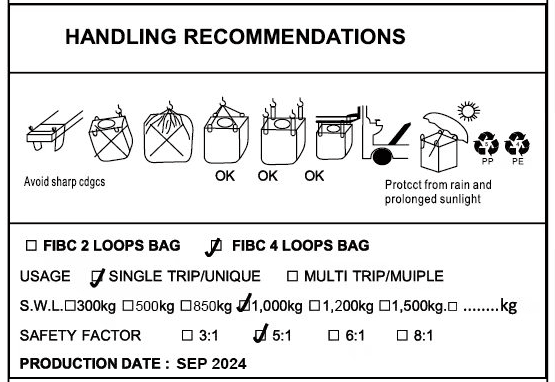
The safety factor only holds if the bag is used the way it was tested:
- Never fill above the SWL. The factor protects against shocks in handling, not against overloading.
- Never refill a 5:1 bag. One fill, one discharge.
- Lift vertically, using all the loops the bag was designed for, and avoid snatch lifts and sudden stops.
- Keep bags out of direct sunlight and water when stored. UV weakens polypropylene over time.
- Inspect loops and stitching before every lift of a reusable bag, and retire any bag with cuts, fraying or loose stitches.
Source: handling recommendations on the label example in the Cotecna certificate (PDF); reuse rules from ISO 21898:2024, clause 6.
How we work at BULKFORTE
We supply FIBCs through contracted manufacturing partners in China. Production, inspection and loading take place at their facilities, and buyers are welcome to audit any factory on site.
Our partner factory has passed SGS factory audits and holds UN dangerous-goods FIBC test reports (Zhengzhou Customs, CNAS-accredited). Copies available on request; other third-party tests (e.g. ISO 21898 top-lift) can be arranged through accredited labs. A UN test report covers only the bag specification that was tested.
Our team brings 20+ years making FIBCs. See how we work for the inspection steps on each order.
Send your spec for a drawing
Tell us what you pack, the weight per bag, how you fill and empty it, and where it ships. We will recommend the safety factor and construction, and send back a drawing to approve. We reply within 12 hours (GMT+8). Get a quote.