How to Verify an FIBC Top-Lift Test Report (Buyer Checklist)
Published 30 October 2026 · Updated 5 November 2026 · BULKFORTE
To verify an FIBC top-lift test report, confirm the lab is accredited (e.g. CNAS, an ILAC MRA signatory) for that test, ask the lab to confirm the report number, and check the tested bag matches your order: dimensions, fabric, loops, liner, SWL and safety factor. Then check the standard (ISO 21898 or UN 13H), test date and results.
On this page
The short answer
A report only helps if it is genuine and covers the bag you are buying. Check six things:
- The lab is accredited, and the FIBC test is in its accredited scope.
- The lab confirms the report number when you ask it directly.
- The tested bag matches your purchase order, line by line.
- The failure load divided by the SWL gives at least your safety factor.
- The test date is recent and the design has not changed since.
- The standard is the right one: ISO 21898 for general goods, UN 13H for dangerous goods.
What a bulk bag test report should contain
ISO 21898 reports (non-dangerous goods)
ISO 21898 is the standard for bulk bags that carry non-dangerous goods. A report to it covers two tests: the cyclic top-lift test in Annex B and the compression/stacking test in Annex C.
- Specimens: at least three — a cyclic top-lift test on the shortest and on the tallest bag of the type, and a compression test on the tallest. If the type has only one height, two specimens are enough.
- Pass criteria: no lifting device breaks to the point it stops carrying its load; no liner protrudes through the outer fabric; no loss of contents; and no damage that makes the bag unsafe.
- Fill material: either test granules with set properties, or the actual product. If the product is used, the bag type is certified for that product only.
- Validity: the standard says a document for a bag type should be valid for three years from issue.
Source: ISO 21898:2024, clauses 5.1, 5.2.1, 5.3 and 6 (preview pages).
What a real report looks like
A Cotecna certificate published online for a 1,000 kg, 5:1 single-trip bag shows the typical layout. It lists:
- SWL, safety factor, class and standard (EN ISO 21898);
- construction: 85 × 85 × 85 cm, 130 g/m² uncoated fabric, U-panel, four 40 mm corner loops;
- four samples submitted by the applicant, and the test date;
- 30 cycles at 2,000 kg, then failure at 5,009 kg on the 31st lift, and where it failed;
- compression at four times the SWL (4,000 kg) for six hours;
- validity dates, an online validator, and "Samples not drawn by Cotecna".
Its annex lists what the report covers — a range of base sizes, no discharge spout, one filling only. Step 3 checks limits like these.
Source: Cotecna Inspection India, test certificate of FIBC issued 23/07/2022 (PDF).
UN dangerous-goods reports (13H1–13H4)
Bags for dangerous goods are tested to the UN Model Regulations and carry a UN code. For woven plastic bags: 13H1 uncoated, no liner; 13H2 coated, no liner; 13H3 uncoated, with liner; 13H4 coated, with liner. The tests include:
- Top lift: six times the maximum permissible gross mass, held for five minutes.
- Stacking: 1.8 times the combined maximum gross mass of the bags that may be stacked on it, for 24 hours.
- Drop and topple: height set by packing group — 1.2 m for packing group II, 0.8 m for packing group III. Check which packing group your cargo needs.
- Tear: a 100 mm cut at 45° through one wall, then twice the maximum gross mass; the cut must not grow by more than 25%.
- Righting: the fallen bag is lifted upright by its loops without damage.
A UN test report covers only the bag specification that was tested.
Source: Codefine, "How to test UN-rated bulk bags" (codefine.com); Southern Packaging, "UN-certified FIBC testing procedures" (southernpackaginglp.com); Media International, UN FIBC classes (mediaint.co.jp). The binding text is the UN Model Regulations, chapter 6.5 (UNECE).
Cyclic top-lift vs single top-lift
ISO 21898 lifts the bag repeatedly, then to failure, proving a safety factor. A UN top lift holds six times the gross mass for five minutes and gives no 5:1 or 6:1 rating.
Step 1: Check who issued it (accreditation)
Find the lab's name, accreditation body and registration number — for a CNAS-accredited lab, usually a number starting with "L". Then:
- Look the lab up in the CNAS accredited-laboratory directory and check that FIBC testing (ISO 21898) or UN packaging tests are in its accredited scope.
- For labs elsewhere, confirm through the accreditation body named on the report. The ILAC list of MRA signatories shows which bodies take part in mutual recognition, and ILAC explains how to find accredited bodies.
A directory confirms the lab and its scope, not an individual report — that is Step 2.
Step 2: Verify the report itself
- Check the report number, date and signature.
- Use the issuer's online validator if it has one — the Cotecna certificate above points to one.
- Email the lab and ask it to confirm the report number, the date and the applicant. Take the contact details from the lab's own website, never from the PDF you were sent.
Step 3: Match the tested sample to your order
Put the report next to your purchase order and compare line by line:
| On the report | On your PO | What to check |
|---|---|---|
| Base and height | Your dimensions | Inside the size range the report covers |
| Fabric weight (g/m²) | Your fabric | Same or heavier, same type |
| Coated / uncoated | Your coating | Same |
| Loop type, number and width | Your loops | Same design |
| Liner | Your liner | Same type |
| Top and bottom (spouts) | Your spouts | Allowed by the report |
| SWL | Your SWL | Not higher than tested |
| Safety factor and class | Your SF and class | Same, e.g. 5:1 single-trip |
| UN code (dangerous goods) | Required code | Exact match, e.g. 13H4 |
"Samples submitted by the applicant" means the lab tested what the factory chose to send. If that matters, ask for samples drawn from your production, or witnessed sampling.
Step 4: Check SWL, safety factor and results
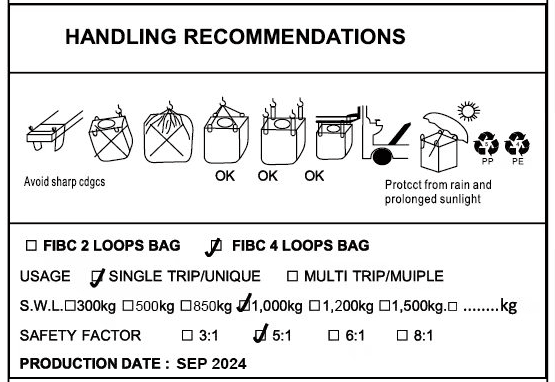
ISO 21898 report: divide the final failure load by the SWL and round down — the result must be at least the safety factor you ordered. In the Cotecna example, 5,009 kg ÷ 1,000 kg = 5.009, rounded down to 5: a pass at 5:1, but not enough for 6:1. Then check that the report states the number of cycles and the load, where the bag failed, and the compression result.
UN report: there is no failure load to divide. Check that the top lift was held at six times the maximum gross mass for five minutes, that the stacking, drop, topple, tear and righting tests are each marked as passed, and that the UN code and packing group match your cargo. A UN test report covers only the bag specification that was tested.
Source: Cotecna certificate (PDF); rounding rule from ISO 21898:2024, clause 3.1.7.
Step 5: Check dates and validity
Note the test date and any expiry date — ISO 21898 suggests three years for a bag type. Then ask: has the design changed since? A new fabric, loop or liner can mean the report no longer covers the bag.
Red flags
| What you see | Why it matters |
|---|---|
| No accreditation body or number | You cannot check the lab at all. |
| The lab's scope does not include FIBC or packaging tests | An accredited lab can still be unaccredited for this test. |
| Different size, fabric or loops from your order | The report proves a different bag. |
| No report number, or signs of editing in the PDF | The document may not be genuine. |
| Report in another company's name, with no link to your factory | It may belong to someone else's product. |
| A "certificate" with no test data | No loads, cycles or results means nothing was shown. |
| A claim that every bag is UN-certified | UN reports cover the specification tested, not a whole range. |
What to ask your supplier before you pay
Copy this into your email:
- Please send the full test report for the bag on our order, including all pages and annexes.
- Which lab issued it, and what is its accreditation body and number?
- Does any construction detail differ from our PO, or has the design changed since the test?
- Were the samples drawn from production or submitted by the factory?
- Can you arrange a test on our order with a lab we name?
- Please send photos and video of the finished bags, the labels and the loading.
How we handle test reports at BULKFORTE
Our partner factory has passed SGS factory audits and holds UN dangerous-goods FIBC test reports (Zhengzhou Customs, CNAS-accredited). Copies available on request; other third-party tests (e.g. ISO 21898 top-lift) can be arranged through accredited labs.
A UN test report covers only the bag specification that was tested. The UN reports were issued by the Zhengzhou Customs testing centre (CNAS-accredited); we share copies with buyers individually, never publicly.
Name any accredited lab and the test you need, and we arrange it — SGS, BV and Intertek are examples, not a fixed list. Shipment photos and video are available on request, and we reply within 12 hours (GMT+8).
FAQ
What is an FIBC top-lift test?
It lifts a filled bulk bag by its loops under a load above its safe working load. In ISO 21898 it is cyclic: repeated lifts, then the load rises until the bag fails, proving its safety factor. UN testing instead holds six times the maximum gross mass for five minutes. A UN test report covers only the bag specification that was tested.
What is the difference between ISO 21898 and UN FIBC testing?
ISO 21898 covers bulk bags for non-dangerous goods and proves the safe working load and safety factor with cyclic top-lift and compression tests. UN testing applies to bags for dangerous goods and adds drop, topple, tear, stacking and righting tests for a specific UN-coded design. Passing one does not certify the other. A UN test report covers only the bag specification that was tested.
What do 13H3 and 13H4 mean on a bulk bag?
They are UN codes for flexible IBCs made of woven plastic. 13H3 means uncoated fabric with a liner; 13H4 means coated fabric with a liner. 13H1 is uncoated without a liner and 13H2 is coated without a liner. The code on the report should match the bag you are ordering. A UN test report covers only the bag specification that was tested.
How can I check if a CNAS test report is genuine?
Find the lab in the CNAS accredited-laboratory directory and confirm the test is in its scope. CNAS confirms accreditation, not individual reports, so then ask the lab directly — using contact details from its own website — to confirm the report number.
Does one test report cover every bag a supplier makes?
No. A report covers the bag type that was tested: its dimensions, fabric, loops, liner and SWL, within the limits the report states. A different construction needs its own test. A UN test report covers only the bag specification that was tested.
How many cycles are in an ISO 21898 cyclic top-lift test?
The procedure is in Annex B of ISO 21898, and the report should state the cycles and load used. Published examples, such as a Cotecna certificate, show 30 cycles at twice the SWL before loading to failure. Read the figure on your report.
Do I need a UN-certified bag for my product?
Only if your product is classified as dangerous goods for transport. The UN classification of your product decides whether a UN-coded bag is required and which packing group applies. Ask your freight forwarder or the shipper of record to confirm before you order. A UN test report covers only the bag specification that was tested.
Can a test be done on my actual order?
Yes. Name an accredited lab and the test you need, and ask for samples drawn from your production rather than ones the factory chooses. Agree it before production. We arrange it through the lab you choose.
Not sure which test you need?
Send your spec and product. We will tell you which test fits — ISO 21898 or UN — and arrange it through an accredited lab. See how we work or get a quote.
Next step: once the report checks out, inspect the lot before shipment.